


EPHONI : Research Activities
The EPHONI’s activities focuses on three main scientific themes relating to waves and their interactions in micro- and nanostructures :
• Phononics and acoustic metamaterials
• Photonics and plasmonics
• PhoXonics, Phonon-cavity electromechanics and Optomecanics
The aim is to highlight the fundamental physical properties and/or behaviour of devices for applications (in telecommunications, sensors, energy, textiles…) using analytical and numerical calculations. The aim is to investigate the fundamental physical properties and/or behaviour of devices for applications in quantum engineering, telecommunications, sensing, neuro-inspired computing, energy, textiles, and other fields through a combination of analytical calculations, numerical simulations, and experimental investigations. The subjects covered are based on contractual funds, with strong links to local, national and European partners for experimental demonstrations.
Contact : Gaëtan Lévêque gaetan.leveque@univ-lille.fr
Permanent members
- Gaëtan Lévêque, Professeur des Universités
gaetan.leveque@univ-lille.fr / +33 (0)3 20 43 48 09
- Yan Pennec, Professeur des Universités
yan.pennec@univ-lille.fr / +33 (0)3 20 43 68 07
- Abdellatif Akjouj, Professeur des Universités
abdellatif.akjouj@univ-lille.fr / +33 (0)3 20 43 xx xx
- Laurent Carpentier, Maitre de Conférences HDR
laurent.carpentier2@univ-lille.fr / +33 (0)3 20 43 xx xx
- Ophélie Saison-Francioso, Chargée de Recherche au CNRS
ophelie.saison-francioso@univ-lille.fr / +33 (0)3 20 43 64 92
- Xin Zhou, Chargée de Recherche au CNRS
xin.zhou@cnrsiemn.fr / +33 (0)3 20 4319 xx78 26 xx
- Bahram Djafari-Rouhani, Professeur Émérite
bahram.djafari-rouhani@univ-lille.fr / +33 (0)3 20 43 xx xx
- Léonard Dobrzynski, Directeur de Recherche Émérite
leonard.dobrzynski@univ-lille.fr / +33 (0)3 20 43 xx xx
- Michele Diego, Chargé de Recherche au CNRS
diego@iis.u-tokyo.ac.jp / +33 (0)3 20 43 xx xx
Étudiants en thèse
· Nouh Krai / nouh.krai@univ-lille.fr
· Charlotte Demullier / charlotte.demullier@univ-lille.fr
· Arnob Dutta / arnob.dutta@univ-lille.fr
· Xingyun Lixingyun / xingyun.li@univ-lille.fr
· Theresa Farah / theresafarah2104@gmail.com / theresa.farah@univ-lille.fr
· Loic Flis / loic.flis@univ-lille.fr
· Ahmad hamyeh / ahmad.hamyeh.etu@univ-lille.fr
· Raffaël Levrai / raffael.levrai@gmail.com
· Stefan Sandu / stefan.sandu@univ-lille.fr
Post-docs
· Monika devi Koijam / koijamm@univ-lille.fr
· Hicham Mangach / hicham.mangach@univ-lille.fr
· Simitha Sasi / simitha.sasi@univ-lille.fr
Anciens membres :
· Najat Ahmidayi
· Oumaima Haidar
Phononics and acoustic metamaterials
-
unpublished data, ephoni
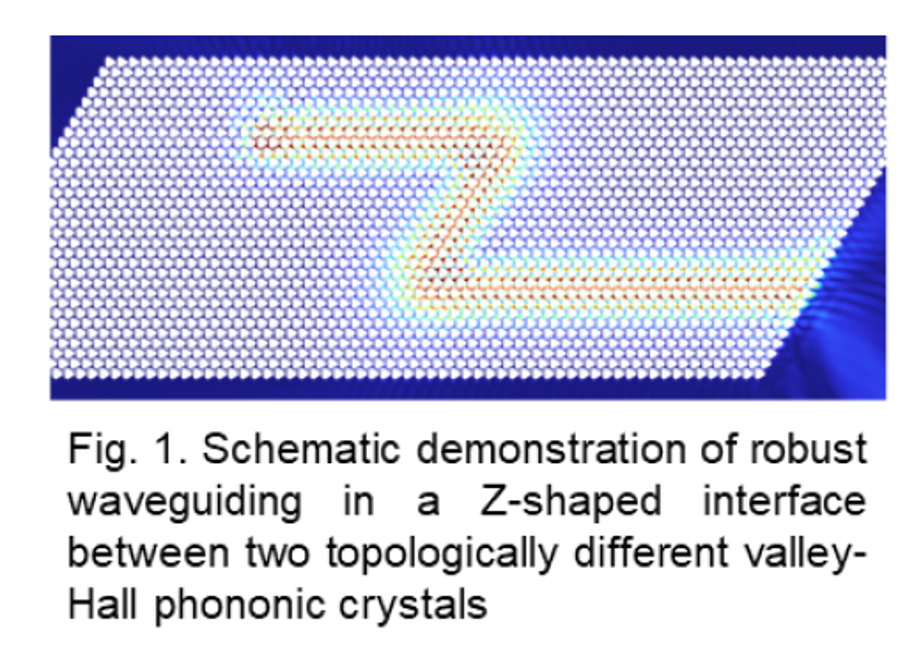
Phononic topology. We have contributed to the field of phononic topological insulators since 2017 [PRB18], in particular in pillar-on-plate or pillar-on-bar structures. Thus we have proposed structures realising robust modes at the interface of different topological structures, wedge, and vortex modes [JPhysD19, PRB19, MSSP22]. These concepts were applied to bars supporting pillars [PRB20], then extended to disordered structures [APLMat24]. Extensions to non-hermitic structures are in progress, in collaboration with B. Bonello (INSP Paris) and Y. Jin (Tongji University, Shanghai), supported by the LEIT (ERC C. Sotomayor-Torres) and Magnific (Horizon EU) projects. We are currently involved in the ANR TWEM project, led by Olga Boyko, in collaboration with C2N and INSP. The project focuses on demonstrating and exploiting topological insulator properties in phononic crystals.
- Acoustic metamaterials and metasurfaces. In collaboration with Tongji University (Shanghai) and INSP Paris, we have studied: (i) metasurfaces for focusing and sub-wavelength imaging [PRApp2021,APLMat21], a methodology also used for NOEMS devices [APLMat24]. (ii) Properties of non-hermitic systems [PRApp22, APL22, APL23], including the existence of exceptional points and their defect detection properties, non-reciprocal propagation in a periodic system, and skin modes. (iii) Models of seismic metamaterials, for insulation against vibrations propagating at very low frequencies [IJMS21], with an application to the nuisances caused by train traffic [EngStruct23] in collaboration with the University of Mons. On the field of Acoustic insulation, we studied locally resonant structures based on Helmholtz Resonators (HR). The study focused on analysing the behaviour of coupled HRs in the near and far fields. The numerical results were compared with experimental measurements using ping-pong balls as HRs [JAP22, JAP23] (European partnership ITN MSC, INSPIRE). The MSCA ITN METACMED project focuses on metamaterial (MM) and phononic-crystal (PC) structures designed to harvest mechanical energy generated during human walking. Two main research topics are investigated in our group: (i) auxetic membrane structures integrating piezoelectric energy-harvesting devices, and (ii) metamaterial-based insoles capable of converting mechanical energy generated during walking into electrical energy.
- Sensors. Characterising the properties of liquids is of interest in many fields (automotive, oil industry, food, medicine, pharmaceuticals). We have demonstrated the use of phononic crystals for detecting liquid properties [AdvApM19, APLMat21]. We have introduced tubular phononic crystals (ANRi-DFG Tubular Bell), suitable for transporting liquids in structures such as pipes, tubes or capillaries, and demonstrated their effectiveness in determining the density and molarity of various liquids [JAP21]. We have studied the effects of liquid viscosity on transmission responses, with the aim of determining the physical parameters of the fluid (density, speed of the fluid and sound waves, viscosity) [Cryst22, Sens22].
- Random structures. In the ANR RANdom (2018-2022) we have theoretically and experimentally studied the localisation of surface acoustic waves (SAW) at high frequency (∼GHz) in random metasurfaces composed of aluminium scatterers [JAP23].
Photonics and plasmonics
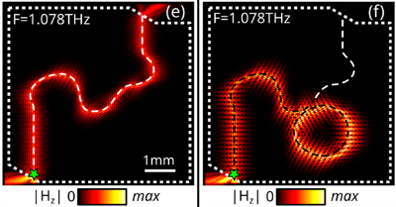
Figure 1: Figure: Gaëtan Lévêque, Yan Pennec, Pascal Szriftgiser, Alberto Amo. APL Photonics 9, 126107 (2024).
Photonic topology. In 2019, we initiated an initial collaboration with the Polytechnical University of Valencia, Spain, on the study of triangular topological cavities. This work is being extended in collaboration with PhLAM [Photoniques24] and the Nano-Micro-Systems and Photonique-THz groups at IEMN. We have demonstrated numerically and experimentally that the shape of the photonic crystal and the geometry of the interface between the two topological image networks can be used to control the conduction and filtering performance of THz signals for 5G and 6G communications networks [PRA23, JLT24], APL24]. Funding by the ULille C2EMPI CDP (2024-28).
-
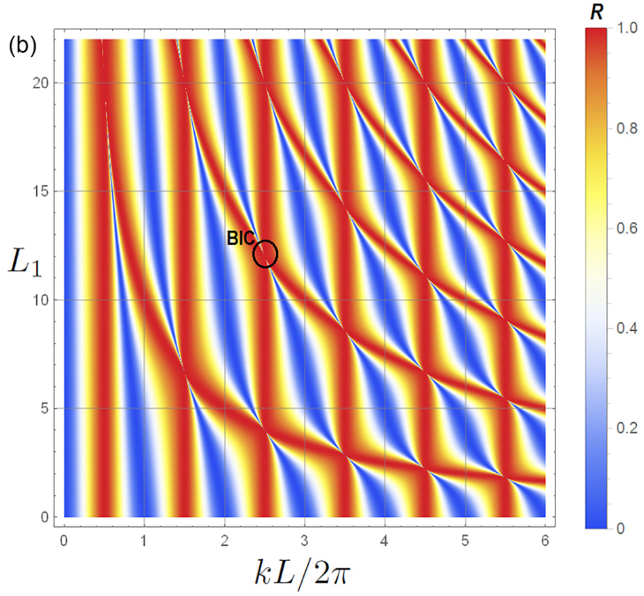
Figure 2: L. Dobrzyński et al, Phys Rev B 110, 035428 (2024)
Bound-in-continuum (BIC) states. Bound-in-continuum states are resonances with zero width (infinite lifetime). They are of current interest because of the narrow Fano type resonances, transparency or induced electromagnetic absorption to which they can give rise and their applications for filtering or sensors. Since 2017, we have proposed different cavities supporting BICs in 1D microwave or plasmonic guides, in particular to highlight Friedrich-Wintgen-type BICs [PRApplPPL21, PRB22, PRAppl23]. These studies have also been extended to acoustics. We have demonstrated the possibility of directly observing the BIC fields inside the cavity [ComPh24, PRRes23]; also, a new mechanism for topological interface modes has been proposed, based on the inversion of band symmetry around a flat band [PRB23].
- Plasmonics for nano-Raman instrumentation. We have theoretically studied and experimentally produced TERS tips for nano-Raman (collaboration between IEMN Physics and Horiba Villeneuve d’Ascq, ANR PRCE Tiptop [JPCC19]). With a joint IEMN/Horiba-Jobin-Yvon team, we have developed innovative tools for the physico-chemical characterisation of nanomaterials using AFM and TERS, or peak exaltation infrared spectroscopy (FEDER Région Hauts-de-France, 2018-2020). A CIFRE thesis was defended in 2019 as part of the ANR Tiptop [NanoAdv22].
- Plasmonic couplings in disordered metal nanoparticle systems. As part of the ANR ‘Random’ programme, we are studying disordered assemblies of lithographed metal particles on metallised substrates, in particular by using a coupled dipole method to describe the interaction of disordered metal spheroids placed on the plasmonic substrate [ACSOmega23]. This approach will make it possible to study a large number of particles and configurations, which is difficult using ‘exact’ numerical methods such as FDTD or FEM. Applications to the coding of physically non-clonable functions are currently being studied.
- Nonlinear properties and complex dynamics in ensembles of metallic nanoparticles. Between 2017 and 2021 (thesis of Z. Ziani) we collaborated with PhLAM U.Lille on the study of the complex dynamics established in ensembles of spherical silver particles [PRB19]. We have highlighted and characterised the spatio-temporal chaos that can be established in these systems, as well as the complex dynamics established in a nanoparticle dimer [AnnPhy20].
- Photonic textiles and thermoregulation. We are studying the interaction of radiation emitted by the human body in the mid-infrared (5-15µm), in order to investigate the transmission, reflection, diffusion and absorption properties of textile membranes and polymer yarns compatible with two main objectives: (i) thermoregulation of the human body through local temperature control while maintaining thermal comfort [SciRep20, Nanomat20, AdvMT22]. This topic is Euro regional (Interreg Photonitex Project (2018-22)), national (ANR PRCE POCOMA (2021-25)), and local with the company DamarTex; (ii) camouflage to electromagnetic waves in the MIR generated and diffused by the human body. This subject, in collaboration with the Defence Innovation Agency, is part of the ‘National defence security for the comfort and protection of combatants’ challenge.
-
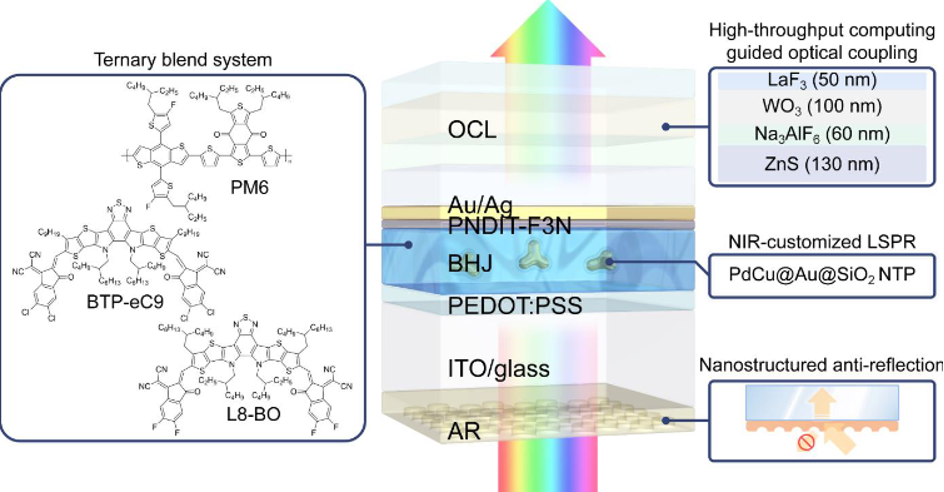
Figure 3: T. Xu, B. Deng et al. Adv. Mater. 2024, 36, 2311305
Solar cells and organic LEDs enhanced by surface plasmons. The collaboration, which includes the Sino-European University (UTSEUS Shanghai), the L2N (UTT) and the ICMCB in Bordeaux, has been extended since 2020 to the study of improving the conversion efficiency and average transmittance in the visible of semi-transparent organic solar cells. Record efficiency has been demonstrated by combining a plasmonic and photonic approach [AdvMat24]. We are also taking part in a programme of international experts, with two workshops planned, the first remote in December 2021 and the second at Shanghai University in October 2023.
- Plasmo-mechanical and plasmonic sensors. In a collaboration started in 2017 between the Ephoni team and the L2N (ex-LNIO) at UTT, we are numerically studying the possibility of exploiting changes in the resonance properties of metallic systems under the effect of mechanical deformation, to produce a new generation of optical deformation sensors based on materials that change colour, for example, when they are subjected to deformation. This theme is being pursued as part of N. Ahmidayi’s thesis (early 2020, AppNanMat18,AnnPhys23). We have also analysed the effect on the sensitivity of biosensors when graphene monolayers are deposited on metal nanoparticles [Vacuum20,OptLasTech20] and proposed new devices using Tamm or SPR plasmonic states for detection ([OptMat24], thesis of O. Haidar (early 2021).
PhoXonics, Phonon-cavity electromechanics and optomechanics
-
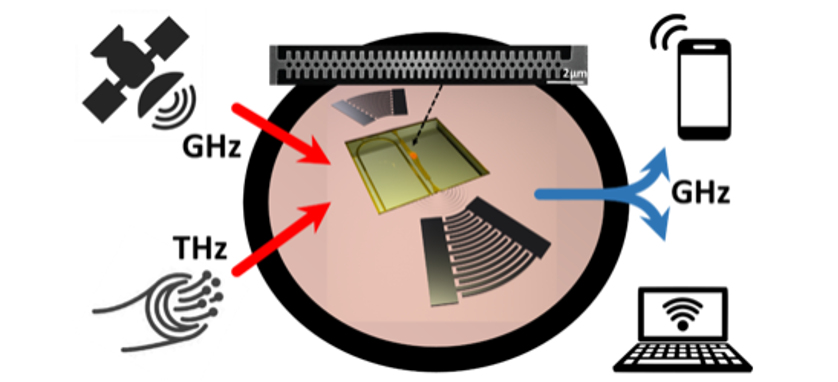 NOEMs. We have introduced and developed (FP7 2009-12, Tailphox) the concept of phoXonic crystals, which can co-localise phonons and photons. The first experimental results of opto-mechanical coupling were obtained in a phoxonic nanoguide [NatCom14]. Through the European Phenomen H2020 contract, we have extended optomechanical coupling to phoXonic cavities [Phot20]. Two new European contracts (Magnific (Horizon Europe 2022-26); Musician (Chist-Era 2022-26)) aim to integrate elementary devices, such as Nano-Opto-Electro-Mechanical Systems (NOEMS). The aim is to produce the first optically controlled phonon sources and detectors, integrated into phonon circuits at hypersonic frequency (GHz). We are also working on the design of very high frequency cavities (8-12 GHz) for satellite applications.
- Phonon-plasmon coupling. We have studied (ANR RANdom) the acousto-plasmonic coupling of nanoparticles deposited on a film on a substrate, using plasmonic modes analogous to metal-insulator-metal modes [PRApp20, OptExp21]. In parallel, we collaborated (ERC of G. Fytas) on a study of the vibration modes of colloidal particles [PRL22, ACSNano23] and silver cylinders in a polymer matrix [JPhysChem21,ACSNano22]. In addition to highlighting the modes of individual or coupled particles, this study has shown the importance of the laser wavelength for optomechanical coupling. We also worked on the numerical simulation of all the optomechanical and photoelastic couplings involved in the plasmon-phonon interaction, using open-source methods (e.g. FreeFem++, gmsh, etc.) [JPhysChemC20].
- Microwave optomechanical devices for on-chip thermometry. This topic was funded by the Région-MOC and ISITE-MOST projects, also in collaboration with (ERC ULTNEMS). We developed a 4K on-chip thermometer based on a novel NEMS device (silicon nitride drum resonator) fabricated at IEMN, which improves the coupling strength by more than a factor of 10 [NanoLett2021]. We also contributed to the optomechanical measurement setup and successfully cooled the nanomechanical resonator to its quantum ground state at the Institut NEEL [NatureComm2021].
-
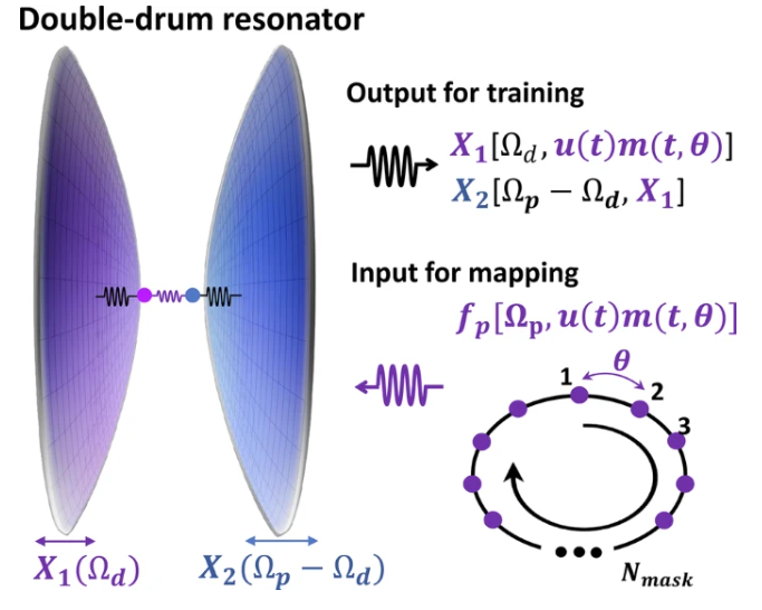 2023–present. Use of coupled vibration modes to construct artificial neural networks for reservoir computing development. To build such a network, we focus on multiple coupled phononic/photonic modes (NOEMIA Chist-ERA 2023–2026) and coupled nanomechanical networks (ANR-MORETOME 2023–2026). Two strong collaborations have been established around these two topics. By taking advantage of phonon-cavity, we explore phonon-based unconventional computing in coupled double-drum electromechanical resonators [NanoLett2022]. Our work focuses on implementing computational reservoirs using two experimental platforms: (i) encoding virtual neuron networks in coupled phononic modes (CHIST-ERA NOEMIA, 2023–2026) [MNS2026] and (ii) building physical networks of coupled nanomechanical resonators (ANR MORETOME, 2023–2026).The first is based on the European microkelvin platform, in collaboration with Aalto University, the University of Nottingham, LOMA, and the Institut NEEL, to develop microwave optomechanical quantum circuits. The second is based on the NOEMIA project, in close collaboration with the University of Southampton (UK) Southampton, the Czech Academy of Sciences (CZ), and National Chung Cheng University, (TW). The second platform was developed in collaboration with LOMA and Institut Néel to create microwave optomechanical quantum circuits and use microwave photons to read out computational results.
- 2026-2030 Detecting quantum fluctuation assist phonon tunneling : This topic is funded by ANR – DASH project. The aim is to detect Casimir forces that mediate phonon tunneling between two vibrational modes through developing a state-of-the-art quantum phonon/photon sensing setup. This project is developing in collaboration with Institut Néel and Laboratoire Charles Fabry.