

Over the last decade, connected objects have become an important part of our daily lives for a variety of applications (leisure, surveillance, measuring vital health parameters, etc.) - this is the field of the Internet of Things (IoT). As soon as these objects are mobile (watches, drones, etc.), their autonomy is generally rapidly limited. Managing to supply them with sufficient energy is now a major challenge for research. This is also the case for even smaller communicating objects, which are about the size of a grain of rice. These miniature objects could be used for the local delivery of drugs to the human body, the monitoring of polluted areas that are inaccessible or the medical surveillance of patients.
In an article in the newspaper Energy & Environmental Sciencea teacher-researcher at the university (see box) and two colleagues from Nantes have produced a detailed review of the challenges of energy autonomy for the Internet of Miniature Objects. To ensure this autonomy, two complementary electrochemical energy storage devices are the focus of intense research by the various laboratories involved. The first is responsible for supplying continuous energy to the object. It is based on miniaturised lithium ion batteries.
 The second, which is the focus of this article, is manufactured to respond to intense current peaks. These are very fast, millimetre-sized supercapacitors: micro-supercapacitors.sators. It's difficult to store a large amount of energy in such a small space. Increasing it significantly is the focus of current research. But nature offers a number of ways of improving performance. For example, to maximise the surface area for exchanging oxygen with the blood, our lungs contain hundreds of millions of alveoli in a 3D structure reminiscent of a tree. Similarly, in micro-supercapacitors, the use of the third dimension makes it possible to increase the surface area of interaction between their two main components (the electrode materials and the electrolyte ions) without altering the size of the object. By mimicking these biological structures, the performance of 3D micro-supercapacitors improves significantly, enabling them to store a quantity of energy never achieved by their 2D predecessors.
Christophe Lethien is a lecturer at the University of Lille, at the faculty of science and technologyand researcher at theInstitute of Electronics, Microelectronics and Nanotechnologies (IEMN). The article is published in collaboration with Jean Le Bideau and Thierry Brousse, teachers atUniversity of Nantes and researchers at theNantes Materials Institute (IMN). The three researchers are members of the electrochemical energy storage network (RS2E).
Chal lenges and prospects of 3D micro-supercapacitors for powering the internet of thingsChristophe Lethien, Jean Le Bideau and Thierry Brousse, Energy Environ. Sci., 2018. In this review article, the authors discuss at length the technologies and topologies that make it possible to manufacture these micro-supercapacitors, as well as the technological hurdles currently holding back the industrial transfer of these technologies.

 PLAK
Thursday, October 25, 2018 at 10:30
Bâtiment M6, Boulevard Paul Langevin
Faculté des Sciences et Technologies de Lille
For realistic 3-D feedback flow control applications, wall measurements tend to be more practical than velocity field measurements. The measurement of mean and fluctuating wall shear-stress and pressure in a boundary layer finds applications both in industry and the scientific community. Time-resolved data can provide physical insight into complex flow phenomena, including turbulent viscous drag, transition to turbulence, and flow separation. The ability for the direct measurement of wall shear-stress as a vector field offers advantages over indirect measurements for pressure sensing for separation detection and flow state estimation for 3D flow control applications. Specifically, when the control objective is often skin-friction or pressure drag reduction, a direct measurement of these quantities may be preferable. This talk presents the design, fabrication and calibration developments of a direct MEMS-based capacitive shear stress sensing system to address both fundamental physics measurements and flow control applications.

 PLAK
Friday, October 26th, 10H00,
Amphitheater – IEMN
Faculté des Sciences et Technologies de Lille – Avenue Poincaré, Villeneuve d’Ascq
To understand and mitigate the impact of noise sources on an aircraft, aeroacoustic researchers are in need of a high performance, low cost microphones to address the increasing noise restrictions on commercial aircraft. Existing commercial sensors, even with their relatively high cost, in some cases constrain the quality and type of measurement that may be achieved. This talk presents the design, fabrication and calibration developments of the first truly flush-mount piezoelectric microelectromechanical (MEMS) dynamic pressure sensor with associated packaging for aircraft fuselage arrays. Through-silicon-vias (TSVs) are incorporated into the fabrication of the sensor to eliminate front-side wire bonds and enable an overall flush surface for the packaged sensor that minimizes flow disturbance. The developed packaging method for the sensor demonstrates an overall flushness to within 10 μm, showing substantial improvement from any previously reported efforts.
GHOUILA-HOURI Cécile
Thesis defence
26/10/2018 – 13:30
Amphithéâtre IEMN – LCI, Villeneuve d’Ascq
Composition du jury
|
Rapporteur |
M. Jean-François MANCEAU |
Professeur à l’Université de Franche-Comté |
|
Rapporteur |
M. Azeddine KOURTA |
Professeur à l’Université d’Orléans |
|
Examinatrice |
Mme Elisabeth DUFOUR-GERGAM |
Professeur à l’Université Paris Sud Orsay |
|
Examinatrice |
Mme Isabelle DUFOUR |
Professeur à l’Université de Bordeaux |
|
Examinateur |
M. Mark SHEPLAK |
Professeur à l’Université de Floride |
|
Directeur de thèse |
M. Abdelkrim TALBI |
Professeur à Centrale de Lille |
|
Directeur de thèse |
M. Philippe PERNOD |
Professeur à Centrale de Lille |
|
Encadrant de thèse |
M. Quentin GALLAS |
Ingénieur de recherche à l’ONERA |
|
Encadrant de thèse |
M. Eric GARNIER |
Ingénieur de recherche à l’ONERA |
Development of wall shear stress and pressure micro-sensors for turbulent flows measurements and flow control

IEMN – Institut d’Electronique de Microélectronique et de Nanotechnologie
Univsersité de Lille – Avenue Poincaré – Villeneuve d’AscqThursday 18th – Friday 19th October 2018
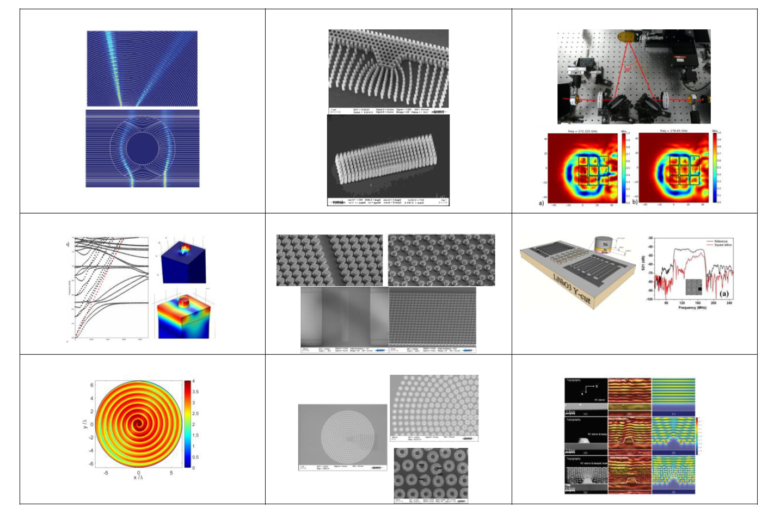
An international workshop on gradient-index metasurfaces will be organized by the departments of Micro and Nano Optoelectronics (MNO-dept), Physics and Acoustics of IEMN in October 2018. It will aim at presenting the current status in the field of spatially dispersive micro-structured metadevices for electromagnetic and acoustic waves and the latest advances in this research area seeking disruptive technologies for the next generation of information and communication systems.
The topic of main interest will include, but will not limited, to wave manipulation devices (magnitude, phase and polarization), reconfigurable and tunable electromagnetic metamaterials at microwave, THz and optical frequencies, acoustic metadevices from infra- to ultra-sound spectrum, antenna applications, sensor network in particular for IoT, reflect- and transmit-arrays for the 5th generation of telecommunications systems, metamaterial for sensing, novel metamaterial concepts, numerical modelling, experimental techniques and characterization of dispersive metasurfaces.
The workshop will comprise keynote presentations from experts in the field as well as oral and poster contributions.
Abstract submission closed : Tusday 31st July 2018It is still possible to submit a poster contribution… Submit a poster abstract
Registration: Monday 1st October 2018
All participants, contributors and attendees, are encouraged to register on the workshop website as early as possible.
Fees: No registration fees are requested.
Papers should be 1 page long with a short abstract and a main body where the technical content and novelty of the work should be presented. They have to be submitted as camera-ready copy pdf files. See below to register and submit your abstract…
Registration & Abstract submission
All participants are encouraged to register. To register please use this link… Registration only
It is still possible to submit a poster contribution… Submit a poster abstract
The Workshop will take place in the Amphitheater of main building of IEMN, Institut d’Electronique, Microélectronique et de Nanotechnologie
Cité scientifique – Avenue Poincaré – 59652 VILLENEUVE D’ASCQ CEDEX
The building is located 300m south from the “4 cantons – Grand Stade” subway station. (termial of the Yellow subway line).
This station can be reached in 20 minutes from the “Lille Flandres” and “Lille Europe railroad stations”.
Contact : Didier Lippens
Mail : didier.lippens@iemn.univ-lille1.fr

 Samir M. PERLAZA
Chargé de Recherche à l’INRIA
Visiting Research Scholar at Princeton University, NJ, USA
Editor of the IEEE Trans. on Communications
Editor of the IET on Smart Grids
In this talk, a review of recent advancements on simultaneous information and energy transmission (SIET) is presented. More specifically, SIET refers to communication systems in which a set of transmitters aim to simultaneously carry on two tasks: information transmission to a set of information receivers (IRs); and energy transmission to a set of energy harvesters (EHs). The performance of SIET is often measured by the information and energy transmission rates that can be simultaneously achieved under certain reliability constraints, e.g., decoding error probability (DEP) and energy shortage probability (ESP). The fundamental limits of SIET consist of the largest set of information and energy rates that can be simultaneously achieved with bounded DEP and ESP. In general, these fundamental limits are often referred to as the information-energy capacity region. The talk focuses on the study of the information-energy capacity region of three channel models: point-to-point channels, multiple access channels and interference channels.
Samir M. Perlaza is a chargé de recherche with the Institut National de Recherche en Informatique et en Automatique (INRIA), France, and a visiting research scholar at the Department of Electrical Engineering at Princeton University (NJ, USA). He received the M.Sc. and Ph.D. degrees from Ecole Nationale Supérieure des Télécommunications (Telecom ParisTech), Paris, France, in 2008 and 2011, respectively. Previously, from 2008 to 2011, he was a Research Engineer at France Télécom – Orange Labs (Paris, France). He has held long-term academic appointments at the Alcatel-Lucent Chair in Flexible Radio at Supélec (Gif-sur-Yvette, France); at Princeton University (Princeton, NJ) and at the University of Houston (Houston, TX). His research interests lie in the overlap of signal processing, information theory, game theory and wireless communications. Dr. Perlaza is an Editor of the IEEE Transactions on Communications and the IET Smart Grids. He has been distinguished by the European Commission with an Alban Fellowship in 2006 and a Marie Skłodowska-Curie Fellowship in 2015.
 Contact:
CITI Laboratory at INSA-Lyon
Domaine Scientifique de la Doua
Bâtiment Claude Chappe
6 avenue des Arts. 69621, Villeurbanne. France
Tel +33 6 73 56 88 05
samir.perlaza@inria.fr

Athmane TADJINE
Thesis defence
jeudi 27 septembre 2018 à 10h00
amphithéâtre de l’IEMN

Thesis defence
31/08/2018 – 10:30
Amphi IEMN Campus de Valenciennes Mont Houy
In railway freight transport, wagons tracking is necessary to identify sensitive elements (transport of hazardous materials, perishable goods …) and the associated information (content, weight, location) could be useful for logistic management. The aim of this thesis is to propose a short-range wireless communication system, which meets these needs. The constraints of rail environment such as flexibility, technical installation difficulties, low energy consumption and the risk of electromagnetic disturbances, causes more difficulties to insert wireless technologies in railway environment. A comparative study of existing communication systems has identified the ZigBee technology as the most appropriate to design the communication between wagons and between wagon and infrastructure for the studied application. A comparison of different possibilities for positioning of ZigBee devices was carried out. Experimentations in presence of vehicles and containers have been realized. The impact of electromagnetic disturbances issued from rail power infrastructure and from surrounding RF transmitters, has been studied. Disturbances intentionally generated to damage the proposed system, have been also analyzed
THESIS COMMITTEE :
– Thesis supervisor(s): Sylvie BARANOWSKI
– Referees: Catherine ALGANI, Mohamed HIMDI
– Examiners: Laila CHAKOUR, Bélahcène MAZARI, Ahmed RHIAT, Atika RIVENQ
Conference Chair Michaël Baudoin – Chair Professor
29-31 August, 2018
IEMN – Villeneuve d’Ascq
This annual meeting is returning to Europe in 2018.This focused meeting is dedicated to exploring the science, engineering, and use of micro- to nanoscale acoustofluidics.
In particular the scope of the conference covers:
https://cbmsociety.org/conferences/acoustofluidics18/

Sponsors