
Ultra-confined terahertz waves
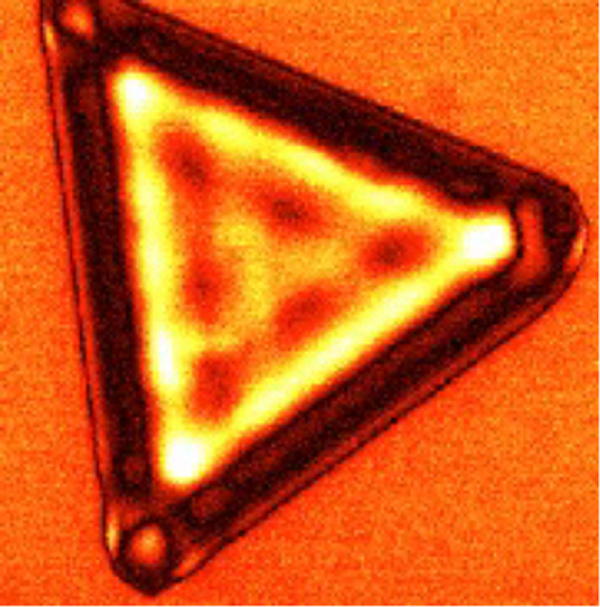
Terahertz (THz) waves fall within the range of electromagnetic frequencies between the radio waves used by our cell phones (microwaves) and infrared light (emitted by hot objects, for example). They are being considered for the development of future ultra-high-speed communication systems, such as 6G, as well as for imaging (e.g., security) and molecular detection [1].
In this work [2], we demonstrated a record reduction in the wavelength of THz waves by a factor of several hundred when they propagate through very thin lead iodide (PbI₂) crystals (a few hundred nanometers thick). The wavelengths are then reduced to a few micrometers.
Observing these waves required the development of a specialized “near-field” microscope operating in the THz range. The key component of such a microscope is a metal tip illuminated by the focused beam of a THz laser. This tip acts as a small antenna, concentrating the THz wave at its tip. The tips we used were fabricated at the IEMN’s micro-nanofabrication platform by the company Vmicro [3]. To explain the extreme compression of the observed wavelengths, one must take into account the very distinctive layered atomic structure of PbI₂ crystals. In these crystals, THz waves exhibit very different properties depending on whether they propagate in the plane of the layers or perpendicular to them. This difference is amplified by the fact that at the THz frequencies used in our microscope, the lead and iodine atoms are vibrating so strongly that the THz photons become very strongly coupled to the atomic vibrations; these are referred to as “polaritons.” Since PbI₂ crystals are only a few tens of micrometers in size, we were able to observe oscillations in the image, proving the existence of ultra-confined polaritons (see figure). Simulations and additional measurements were carried out in collaboration with the CNPEM in Brazil, which confirmed the interpretation of these images.
These observations, made for the first time in the THz range for this type of polariton, open the door to new components for processing and controlling THz waves, such as waveguides, modulators, and very small antennas compatible with on-chip integration.
Learn more
[1] La révolution des ondes térahertz, Julien Bourdet, CNRS le Journal, décembre 2020.
[2] Santos, C.N., Feres, F.H., Hannotte, T. et al. High quality-factor terahertz phonon-polaritons in layered lead iodide. Nature Communications (2026). https://doi.org/10.1038/s41467-026-69027-6
[3] vmicroafmprobes.com
[4] Centro Nacional de Pesquisa em Energia e Materials (CNPEM), Campinas, São Paulo, Brasil
Contact : jean-francois.lampin iemn.fr