
Welding with water
Welding with water, impossible?
Yes, but what happens at the nanoscale?
Capillary cold welding is a process proposed to optimize the electrical conductivity of transparent electrodes based on nanowires. Using an advanced multi-probe microscopy device, the electrical resistance of a single junction between two nanowires was studied. The results establish capillary cold welding as an effective process for creating the flexible, transparent electrodes needed for future (opto)electronic systems.
Whether for photovoltaics, flexible electronics, or medical applications, it is necessary to develop electrodes that are both transparent and conductive. The most conductive materials, metals, are not transparent when they are solid, but become so when formed into a network based on nanowires.
Silver nanowire networks have particularly attractive properties in terms of transparency, conductivity, and biocompatibility. However, there is still significant residual electrical resistance due to the interconnections between the nanowires. To achieve better conductivity, the industry uses post-treatment processes for the electrodes, such as high-temperature annealing to weld the nanowires together. But this post-treatment is incompatible with the fragile materials used in flexible electronics: organic substrates deteriorate at high temperatures.
In this context, a process is proposed, namely capillary-induced cold welding, which consists of spraying water onto the nanowire networks. Improved conductivity is observed during evaporation. This effect has been attributed to a local pressure effect that fuses the nanowires at the junctions.
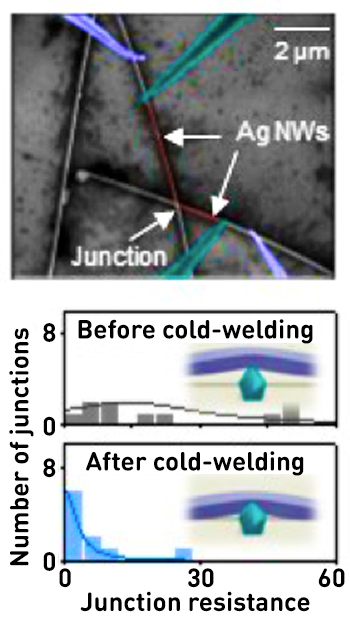
This work is the result of a collaboration between the LMGP Laboratory of Materials and Physical Engineering, an expert in conductive nanowire networks, TRT-Thalès, an expert in components, and the IEMN, an expert in nanocaracterization, as part of the ANR PANASSE project. We conducted a study of interconnection resistances at the single junction scale using a unique equipment available at the IEMN. This device allows four tips to be positioned on a sample with nanometric precision, under the supervision of a scanning electron microscope.
Our study established that the capillary-induced cold welding process produces a junction resistance distribution that is as effective as that obtained after heat treatment. The fusion of nanowires is induced by the capillary forces exerted by evaporating water droplets.
This result demonstrates the strong potential of the cold post-treatment process and illustrates the power of advanced characterization techniques for nanoscale materials engineering.
References
Chernukha, Y.; Bardet, L.; Berthe, M.; Lerond, T.; Mazellier, J.-P.; Gangloff, L.; Denneulin, A.; Diener, P.; Bellet, D. In Situ Multiscale Investigation of Capillary-Force-Induced Cold-Welding of Silver Nanowire Networks. ACS Omega 2025, 10 (46), 55716–55724. https://doi.org/10.1021/acsomega.5c07063.
Contact us: maxime.berthe@iemn.fr / pascale.diener@iemn.fr