
Pierre Koleják receives a Werner von Siemens Award for his French-Czech PhD on spintronic THz ellipsometry
A distinction highlighting a successful French–Czech research trajectory at the interface of terahertz photonics, spintronics and advanced materials metrology.
IEMN warmly congratulates Pierre Koleják, Ph.D., who received the silver medal in the “Best Doctoral Thesis” category of the 2025 Werner von Siemens Awards for his dissertation entitled Terahertz Time-Domain Ellipsometry Based on Spintronic Phenomena. The Werner von Siemens Awards are among the most visible Czech distinctions for young scientists, students and educators in engineering and natural sciences. In the 2025 edition, 662 submissions were evaluated and 22 laureates were selected by expert juries [1].
Pierre’s thesis was carried out in a French–Czech cotutelle framework between VŠB–Technical University of Ostrava and IEMN, under the joint supervision of Kamil Postava and Mathias Vanwolleghem. The collaboration brought together complementary expertise: the original ellipsometry perspective and metrological motivation came from the Czech partner, while IEMN provided the environment in which the spintronic THz source platform, ultrafast THz instrumentation and photonic source-engineering concepts were developed.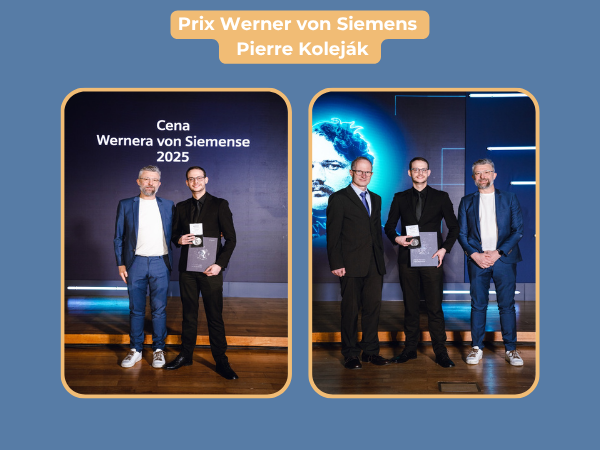
Under the guidance of Mathias Vanwolleghem, spintronic THz emitters entered IEMN as a new research direction and rapidly developed into one of the active axes of the THz Photonics group. Pierre’s PhD played a major role in this acceleration. While the long-term scientific horizon of the thesis was complete THz time-domain ellipsometry, many of its most mature and visible innovations concerned the physics, engineering and control of spintronic THz emitters themselves.
The scientific motivation was a central challenge in terahertz metrology: how to bring the analytical power of ellipsometry into the THz range while fully exploiting the phase-sensitive nature of time-domain spectroscopy. Conventional optical ellipsometry is a reference technique for measuring optical constants, thin-film thicknesses and anisotropies, but its extension to the THz domain remains technically demanding. Complete access to the polarization response of general anisotropic samples requires both amplitude and phase information, together with a high degree of control over the emitted THz polarization state.
Pierre’s dissertation pursued this objective through complete time-domain spectroscopic THz ellipsometry, or THz-cTDSE. The method aims to retrieve the full complex Jones matrix of anisotropic and lossy samples and to derive the corresponding Mueller matrix used in conventional ellipsometry. Pierre also introduced a Pauli-matrix-based representation of the polarimetric response, translating matrix data into physically interpretable quantities such as retardance and diattenuation in different polarization bases. This provides a clearer route from measured THz waveforms to the underlying material physics, especially for birefringent, dichroic, magneto-optical or otherwise anisotropic systems. The approach is particularly relevant in the THz range, where radiation probes conductivity, carrier dynamics, low-energy excitations, phonons and anisotropic responses in technologically important materials.

Pierre Koleják, Ph.D., developed new spintronic terahertz emitters and contributed to the emergence of complete time-domain THz ellipsometry during his French–Czech cotutelle PhD between VŠB–Technical University of Ostrava and CNRS/IEMN.
At the heart of the PhD was the realization that such an ellipsometric platform requires more than a conventional THz source followed by external polarizing optics. The enabling element is the spintronic THz emitter itself, used not simply as a broadband emitter, but as an actively controllable source of polarized THz radiation. In nanometric ferromagnet/heavy-metal multilayers, an ultrafast laser pulse generates a spin current that is converted into a transverse charge current through spin–orbit coupling, producing broadband THz emission. Because the emitted THz polarization is directly linked to the magnetization direction, spintronic emitters provide a unique route to controlling the polarization state at the source, avoiding lossy or mechanically rotated THz polarizing optics.
Pierre’s work contributed to transforming spintronic THz emitters into polarization-programmable metrological components. A first major result was the demonstration of full 360° source-level polarization control using engineered magnetic anisotropy in spintronic multilayers. By designing emitters with controlled uniaxial magnetic anisotropy, the emitted THz polarization could be rotated continuously through the magnetic state of the emitter itself. This is a central point of the work: the polarization is programmed inside the emitting structure, rather than imposed afterwards by mechanically scanned THz optical components. [2]
A complementary route explored voltage-controlled spintronic emitters based on magnetostrictive layers deposited on piezoelectric PMN-PT substrates. In this case, voltage-induced strain reorients the magnetization and thereby rotates the emitted THz polarization. This second approach pursues the same source-level control principle, but replaces magnetic-field actuation by an electrical stimulus. The resulting work on fully reversible magnetoelectric voltage control of THz polarization was published in Applied Physics Letters, selected as a Featured article, and highlighted on the journal cover. [3]
Pierre also tackled one of the main limitations of spintronic THz technology: the relatively low optical-to-THz conversion efficiency of bare multilayer emitters. His work developed a rigorous electromagnetic strategy to maximize useful pump absorption in the ultrathin spintronic stack while also improving the extraction of the generated THz radiation. By integrating spintronic emitters with optimized photonic-cavity concepts, the work demonstrated strongly enhanced THz output while preserving the broadband character that makes spintronic emitters attractive. The resulting Advanced Photonics Research paper, “Maximizing the Electromagnetic Efficiency of Spintronic Terahertz Emitters,” was highlighted on the journal cover and is now recognized as a highly cited contribution in this emerging field. [4]
These results are not isolated source optimizations. Together, they establish the source-side building blocks required for complete THz polarimetry and ellipsometry: broadband emission, enhanced efficiency, controllable polarization and compatibility with compact architectures. In that sense, the ellipsometry was not simply a final application added to the PhD, but the guiding metrological objective that gave coherence to the spintronic source developments.
The scientific environment of the thesis was strongly shaped by the European s-NEBULA FET Open project — Novel Spin-Based Building Blocks for Advanced TeraHertz Applications. The project aimed to create room-temperature spin-based THz building blocks and explicitly included polarization-programmable emitters for ellipsometry among its target applications. Pierre’s work contributed directly to this ambition by addressing the source-side challenges — efficiency, polarization programmability, calibration and metrological use — that must be solved before spintronic emitters can become practical components for advanced THz instrumentation. [5]
The Barrande Fellowship Programme also played an important role by supporting the French–Czech doctoral mobility framework. Barrande is designed to enhance scientific cooperation between French and Czech research teams and funds cotutelle PhDs and short research stays between the two countries. In Pierre’s case, this support helped make the collaboration a genuinely bilateral doctoral project, combining the Czech ellipsometry tradition with the spintronic THz developments led at IEMN.
The work has also opened a durable research line at IEMN. Within the PEPR SPIN / TOAST moonshot project, the group is now extending Pierre’s source-level polarization-control concepts toward fast THz polarization modulation, with the aim of enabling modulation-based detection schemes, improved signal-to-noise ratios and new forms of polarization-resolved THz spectroscopy. In parallel, the ANR PRCI SPINCHIP project, carried out with the Hybrid Photonics Laboratory at EPFL (École polytechnique fédérale de Lausanne), is pushing spintronic THz emitters toward photonic integrated platforms. SPINCHIP aims to develop hybrid photonic–spintronic chips on silicon nitride for compact pulsed and continuous-wave THz generation, with IEMN and EPFL as partners. [6,7]
In this sense, Pierre’s Werner von Siemens Award recognizes more than an outstanding doctoral thesis. It highlights a successful French–Czech research pathway, supported by Barrande mobility and amplified by the European s-NEBULA project. It also marks the emergence of a strong and continuing research axis at IEMN, linking fundamental spintronic THz source physics, complete polarimetric metrology and future integrated THz systems for non-destructive characterization of advanced materials.
Acknowledgement box
Acknowledgements — Pierre Koleják’s PhD was carried out in cotutelle between VŠB–Technical University of Ostrava and IEMN (graduate school ENGSYS, University of Lille), with support from the Barrande Fellowship Programme for French–Czech doctoral mobility. The work also benefited from the European H2020 FET Open project s-NEBULA, which provided the broader collaborative framework for the development of spin-based THz technologies. The research line is now continuing at IEMN through follow-up projects including PEPR SPIN / TOAST, on fast THz polarization modulation, and ANR PRCI SPINCHIP, with EPFL, on integrated spintronic THz photonics.
References
[1] https://www.siemenspress.cz/ceny-wernera-von-siemense-2025/
[2] P. Kolejak, G. Lézier, K. Postava, Jean-François, N. Tiercelin, and M. Vanwolleghem, “360° polarization control of terahertz spintronic emitters using uniaxial FeCo/TbCo2/FeCo trilayers”, ACS photonics, American Chemical Society,, 2022, 9 (4), pp.1274−1285. ; doi:10.1021/acsphotonics.1c01782
[3] Geoffrey Lezier, Pierre Koleják, Jean-François Lampin, Kamil Postava, Mathias Vanwolleghem, Nicolas Tiercelin, « Fully reversible magnetoelectric voltage controlled THz polarization rotation in magnetostrictive spintronic emitters on PMN-PT », Special Topic on Ultrafast and Terahertz Spintronics, Applied Physics Letters, 2022, 120, pp.152404. doi: 10.1063/5.0080372
[4] Koleják, P., Lezier, G., Vala, D., Mathmann, B., Halagačka, L., Gelnárová, Z., Dusch, Y., Lampin, J.-F., Tiercelin, N., Postava, K. and Vanwolleghem, M. (2024), Maximizing the Electromagnetic Efficiency of Spintronic Terahertz Emitters. Adv. Photonics Res., 5: 2400064. https://doi.org/10.1002/adpr.202400064
[5] https://cordis.europa.eu/project/id/863155
[6] https://anr.fr/ProjetIA-22-EXSP-0003
[7] https://anr.fr/Project-ANR-24-CE93-0018
Contact Us
Mathias.vanwolleghem iemn.fr