
Collaborative artificial intelligence-based cybersecurity agents to better protect 6G-compatible connected vehicle networks
This paper is a collaboration between a researcher from IEMN with an industrial researcher from Ericsson.
The main objective was to propose a new robust zero trust agents based on collaborative Artificial Intelligence (AI) algorithms to protect the 6G-enabled VANETs (Vehicular Ad-Hoc Network) from attacks targeting simultaneously the VANETs and 6G infrastructure.
The collaborative AI is based on generative AI and Transfer Learning (TL) algorithms.
Two kinds of zero trust agents were proposed, Local Zero trust systems (LZTS) and Global Zero trust systems (GZTS) that monitor the network and infrastructure with the goal to detect promptly the malicious behaviors.
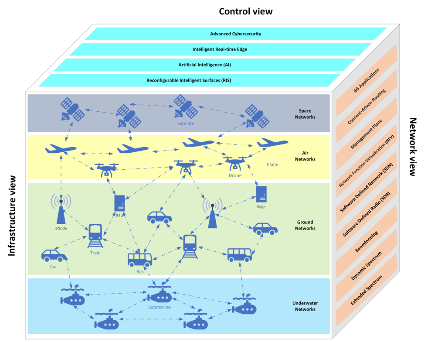
The Sixth Generation (6G) represents the anticipated evolution of wireless communication technology beyond 5G. While 5G was expected to deliver faster data speeds and lower latency than previous generations, 6G was envisioned to push the boundaries even further. 6G is expected to provide seamless global coverage, extending connectivity to remote and underserved areas. Satellite communication, high-altitude platforms, and other innovative solutions could be part of the 6G ecosystem. As the 5G infrastructure, the 6G network is based on four segments, Radio Access Network (RAN), core, edge computing and cloud computing segments.
However, the number of user equipment and internet of things devices that connect to 6G infrastructure could reach a billion of internet devices. Vehicular Ad-hoc Networks or VANETs typically refer to networks of vehicles equipped with wireless communication capabilities, such as Wi-Fi or cellular networks, which enable vehicle-to-vehicle (V2V) and vehicle-to-infrastructure (V2I) communication.
These networks are primarily associated with improving road safety, traffic management, and providing various services to drivers and passengers. The paradigm of 6G-Enabled VANETs is somehow new. It refers to the application of the 6G within the context of VANETs. This paradigm opens specific challenges for 6G such as the need for ultra-high data rates, ultra-low latency, massive device global connectivity and enhanced security.
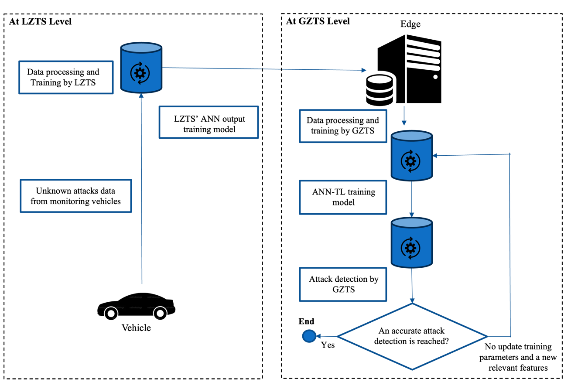
A set of Zero Trust Systems (ZTSs) are activated in the proposed security architecture at the vehicle and edge levels and collaborate to detect the malicious vehicles and external attacks targeting the 6G-enabled VANETs. Two kinds of ZTS are proposed, Local ZTS (LZTS) and Global ZTS (GZTS), which are respectively activated at the trustworthy vehicles and 6G edge servers. (i) LZTS: The neighborhood vehicles (i.e., located within the same radio range) execute a mutual monitoring and detection process with a goal to elect the most trustworthy vehicle and hence this latter will play the role of LZTS. (ii) GZTS: In the 6G architecture, the edge servers manage the vehicles located within their radio ranges by running a set of computation tasks requested by the vehicles.
Two version of the algorithms, a lightweight one and a robust one, were evaluated using “Efficient Detection Time” (EDT) and “Reliable Detection Rate” (RDR).
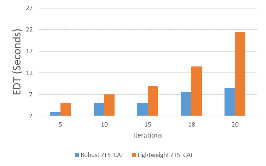
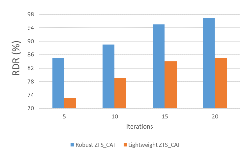
This proposed AI technique could detect accurately the known and unknown cyber-attacks and hence leading the GZTS and LZTSs to detect promptly any malicious behaviors executed by the attackers. This evaluation shows that by activating the collaborative AI techniques, the zero trust systems prevent the occurrence of a high number of cyber-attacks, and specifically when the number of iterations increases. By combining between the generative AI and TL, LZTSs and GZTSs refine their detections over time and hence leading the proposed technique to detect the complex and smart attacks, such as zero-day and collaborative attacks that could target the 6G infrastructure. Therefore, it is a suitable defense framework to secure the 6G network from both internal and external cyber threats.
Contact :