
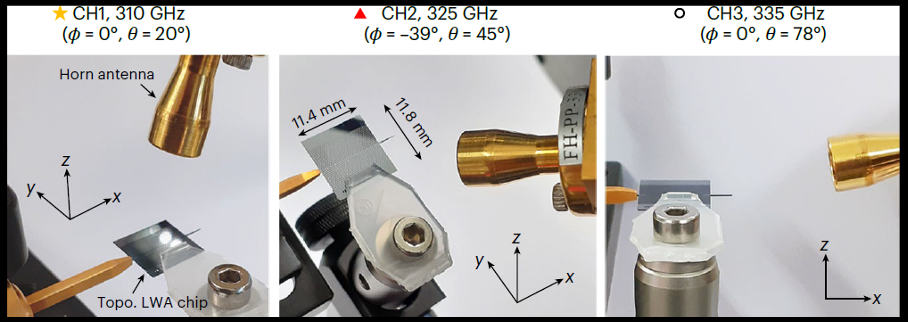
Spatial distribution of THz wave radiation: Each frequency is radiated into space at angles determined by the design of the leaky THz topological waveguide.
Towards 360° connectivity in the THz band
Communications in the millimeter wave and THz bands, offering significant data transfer capabilities, aim to extend existing E-band systems (71-76 and 81-86 GHz). The primary use case to date is supporting core radio deployments for 5G and 6G networks. To this end, direct point-to-point links in new bands (beyond 100 GHz) are under development, with deployments planned in the D-band (140-150 GHz) by 2030 and beyond (H-band, 300 GHz) by 2035-2040.
Beyond this use case, which employs traditional beam-focusing antennas, indoor applications are also being studied. These require different approaches for wave radiation, that has to be designed to close the link budget between transmitter and receiver. Such applications require less directional antennas, featuring wider beamwidth, ideally up to 360° for full space connectivity. Among possible approaches, the use of leaky topological waveguides whose radiation direction depends on the frequency plays a role. In this work, conducted with our partners at NTU Singapore and the University of Notre Dame-USA, the CNRS both characterized THz devices and enabled the implementation of a proof of concept (PoC) for the three-dimensional radiation of the leaky waveguide, which is made of silicon. This leaky waveguide, coupled with THz converters (photomixing), enables the functionalization of the THz source, making it possible to radiate the signal over a large area with a spatial distribution defined by the design of the radiating device. Spatial signal distribution performance ranging from 20 to 28 Gbit/s, and from 310 to 335 GHz, has been achieved with the device, paving the way for spatially distributed point-to-multipoint THz links.
Référence
On-chip topological leaky-wave antenna for full-space terahertz wireless connectivity
Nature Photonics 20, 317–323 (2026)
https://www.nature.com/articles/s41566-025-01825-8
Contact: Guillaume.ducounau univ-lille.fr