

Bottom view of a horizontal soap film deformed by a droplet deposited at the center of the film.
Gravitational waltz on a soap film
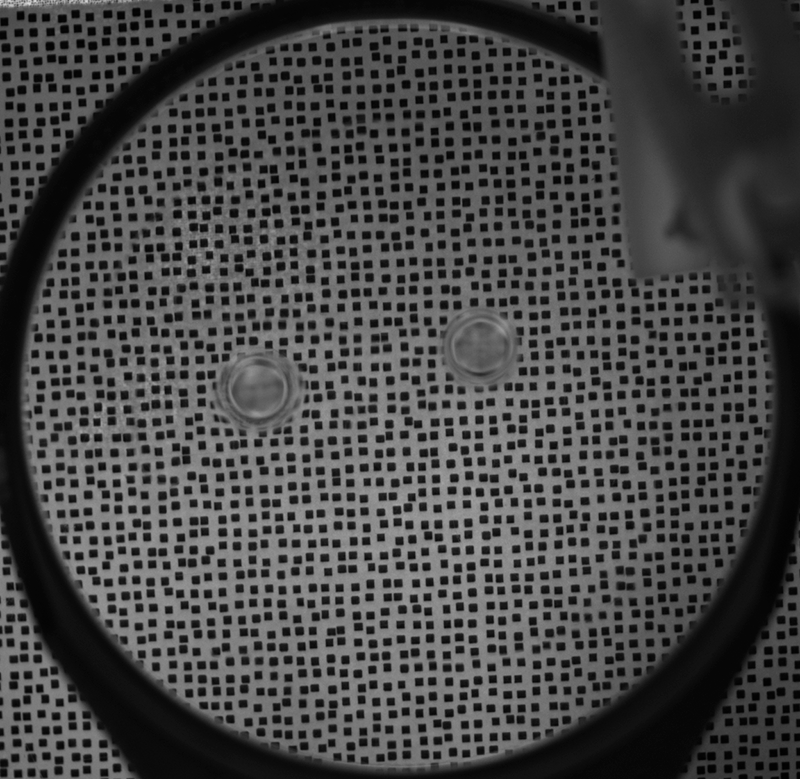
Two liquid lenses orbiting on a soap film. The lenses distort the image of the background located beneath the film.
Gravitational interactions shape the structures of the Universe, from planetary orbits to interactions between galaxies. They give rise to characteristic dynamics such as complex orbits, tidal spiral arms, and bridges, which are commonly observed at astrophysical scales but rarely observed at human scales. Recently, teams from IEMN and the Institut Pprime observed the emergence of such structures when two miscible droplets, placed on a soap film, orbit, collide, and merge.
Experimentally, a horizontal soap film, composed of a mixture of water, glycerol, and surfactant, is formed on a horizontal support. One or several droplets are then deposited onto this soap film, forming stable structures called “lenses,” whose shape results from a balance between capillary and gravitational forces. When multiple droplets are introduced onto the film with an initial horizontal velocity (using a dropslide), they begin to orbit each other and eventually collide and merge, in a choreography reminiscent of galaxy mergers.
The observation of such dynamics is made possible by (i) the formation of stable lenses when droplets are deposited on the soap film, (ii) long-range interactions between these lenses, analogous to two-dimensional gravitational attraction forces, and (iii) the deformable nature of these lenses when they interact. The IEMN team modeled the interactions between orbiting lenses and demonstrated that they originate from the deformation of the film, resulting from a balance between capillary and gravitational forces. They were able to quantify this force and reproduce complex orbits of two lenses with an initial velocity. The next step will be to study and model the collision and merging of the lenses.
This work opens up new perspectives for gravitational analogues, enabling the investigation, at human scales, of simplified representations of phenomena that typically occur at scales beyond the reach of human observation.
This work, published in PNAS Nexus (https://doi.org/10.1093/pnasnexus/pgag079) was highlighted in an article by the newspaper Le Monde :
mickael.baudoin iemn.fr
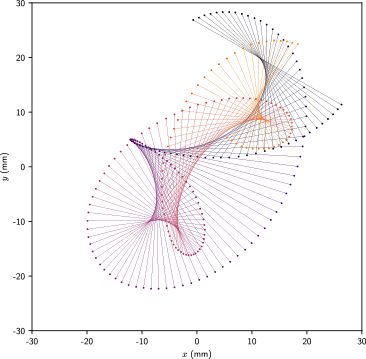
Dynamics of two droplets orbiting on a soap film. The points correspond to the positions of the centers of mass of the two lenses as a function of time, while the line segments connect the centers of mass of the two lenses at each instant.
Référence :
[1] J.P. Martischang, B. Reichert, I. Haouche, G. Rousseaux, A. Duchesne & M. Baudoin, PNAS Nexus, 5, pgag079 (2026)